EYFS - Foundation Stage
Intent:
At Downsway we believe that all children deserve an education rich in memorable experiences that allows our children’s creativity and curiosity to grow, alongside the development of key skills and knowledge. We believe that offering our children a strong foundation and a love of learning gives children the best chance to become well-rounded, happy individuals, ready to succeed. We recognise the importance of giving our children the best possible start to their education by planning and implementing teaching and learning opportunities that support them in reaching their full potential alongside working collaboratively with parents and carers.
It is our intention to provide a stimulating learning environment where all children can work with adults and peers in a climate of mutual respect to develop confidence in their ability to learn. We aim to provide children with a well-structured, safe and active learning environment. This will enable our young learners to develop the skills, attitudes and understanding that support our children to become lifelong learners and encourage them to become active members of our ever-changing society.
To ensure children make outstanding progress, it is our intent to take into consideration the starting points and needs of our pupils as they begin their learning journey. Every child has access to a broad, balanced and differentiated curriculum which prepares them for now and for the future in terms of opportunities and experiences. Following personal interests and individual needs, allows us to plan and provide opportunities throughout our EYFS curriculum to support learning and development and achieve their next steps.
Our EYFS curriculum aims to enable our children to be:
- Competent and creative learners; who are curious about the world around them.
- Secure and confident; who enjoy coming to school and learning new skills and knowledge building on their existing learning.
- Skilful communicators; who connect with others through language and play, ensuring that they play in a vocab rich environment.
Implementation:
At Downsway Primary we follow the Early Years Foundation Stage framework. This is made up of four overriding principles which our early year’s education is based upon:
- Unique Child: Every child is unique child who is constantly learning and can be resilient, capable, confident and self-assured.
- Positive Relationships: Children learn to be strong and independent through positive relationships.
- Enabling Environments: Children learn and develop well in enabling environments, in which their experiences respond to their individual needs and there is a strong partnership between practitioners and parents and carers.
- Learning and Development: Children develop and learn in different ways. The framework covers the education and care of all children in early year’s provision, including children with special educational needs and disabilities.
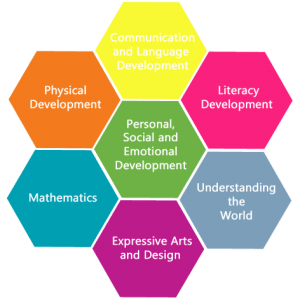
The curriculum provides a play-based and experiential learning environment, combined with focussed teaching and basic skills, to ensure children make rapid progress before moving onto Year 1 and the National Curriculum. The children engage in planned, focussed activities as well as self-initiated and free flow activities. The learning experiences within our Early Years are linked to the seven areas of learning and development within the EYFS. These areas are split into three prime areas and four specific areas. These include:
- Personal, Social and Emotional Development
- Communication and Language
- Physical Development
As children grow and make progress in the prime areas, this will help them to naturally develop skills within the four specific areas. These are:
- Literacy
- Mathematics
- Understanding the World
- Expressive Arts and Design
Children are taught the skills required in the EYFS through bespoke selected topics. These topics are coherently planned to build upon the children’s current knowledge and understanding by a cumulative sequence of lessons. Pupils are encouraged to wonder and ask questions about what they are learning and this information is used to plan subsequent lessons. Parents are regularly informed about their child’s progress through Seesaw communication and ‘Welcome Time’ opportunities to come into the classroom and look through their child’s learning.
Rich first hand experiences (inside, outdoors, visitors and school trips) to widen experiences, awe and wonderment. Exploratory learning and thinking creatively including problem solving across all areas of learning. New vocabulary and concepts through reading and weekly Drawing Club sessions will excite and engage all learners which includes staff modelling standard English and asking high quality questions.
Throughout their first year at Downsway, our children are assessed in relation to their progress towards Development Matters and the Early Learning Goals. These judgements are made on the basis of accumulative observations and in-depth knowledge of the children acquired through ongoing assessments. Next steps are taught in the moment during continuous provision and adult led activities to ensure children are challenged.
All ongoing observations are used to inform weekly planning and identify children’s next steps. This formative assessment does not involve prolonged periods of time away from the children and excessive paper work. Practitioners draw on their knowledge of the child and their own expert professional judgements through discussions with other practitioners, photographs and physical examples such as a child’s drawing/mark making. We encourage parents and carers to share ’Wow Moments’ at home through SeeSaw to help build a picture of the individual child’s development across both the school and home learning environments.
Phonics progress is carefully monitored with regular assessments helping us to ensure the children have a secure understanding of all taught sounds and phonic concepts. The assessments tell us what they can do, what they know and highlight those sounds and concepts some children may need to revisit or practise further. Alongside informal observations, adults formally assess the children’s phonics after each teaching level. This might be every half-term, or at a natural pausing point before moving on to the next group of GPCs or skills. This data then informs the children’s next steps and any support needed to ensure progress. Practitioners use an intervention programme that works alongside the Twinkl phonics scheme to support those children who need further support and who are more able.
Formal assessments in the Early Years Foundation Stage include:
- Baseline: Prior to children starting, staff spend time speaking to the child’s parents, previous settings and read previous learning journey’s to gain an understanding of the whole child and where they are at. During the first half term all staff use ongoing assessments, observations and conversations with the child to develop a baseline assessment. This identifies each individual’s starting points in all areas so we can plan experiences to ensure progress.
- The Statuary Reception Baseline Assessment: This assessment focusses on the following areas of the Early Years Foundation Stage: Personal, Social and Emotional Development; Communication and Language; Literacy and Mathematics. The purpose of this is to show the progress children make from Reception until the end of KS2. This is completed within the first 6 weeks of beginning the Reception year.
- End-of-year assessments: These are finalised during the summer term, summarising each child’s development at that point against the Early Learning Goals and Development Matters.
Impact:
By the end of their first year at Downsway, all children will have reached their full potential and have achieved at least good progress across all areas of learning. Through the delivery of a well-planned, child-led and challenging curriculum, we aim that the pupils will leave our Foundation Stage ready for the next stage in their education and be ready for Year 1:
- Listen intently and responding positively to adults and each other.
- Be resilient learners who are keen to learn and proud of their achievements.
- Demonstrate positive attitudes to learning through high levels of curiosity, concentration and enjoyment.
- Have good personal, physical and social skills.
- Enjoy, listening attentively and responding with comprehension to familiar stories and rhymes.
- Use and understand a wide range of vocabulary.
- Using phonics knowledge to read accurately with increasing speed and fluency.
- Using phonics knowledge to segment the sounds in words, form sentences and write with increasing stamina/forming recognisable letters.
- Have a deep understanding of numbers to 10, subitising up to 5, automatically recalling numbers bonds up to 5 and some number bonds to 10, including double facts.
- Verbally count beyond 20, recognising patterns in the number system. Compare quantities up to 10 in different contexts and explore and represent patterns within number to 10 e.g. odds and evens.